Service
Sub-Zero outdoor refrigeration repair
Service for outdoor-rated Sub-Zero refrigeration in summer kitchens and on pool decks, the harshest position any appliance on this coast is asked to hold.
Symptoms we hear most
- The unit holding overnight but losing several degrees every afternoon
- Rust bleeding from around hinge pins, screw heads or the handle mount
- A circuit that trips on hot afternoons and resets fine in the morning
- Condensation running down the outside of the door in humid weather
- Stainless developing brown tea-staining that polishing does not remove
- A door seal that has gone hard and no longer springs back
An outdoor refrigerator in Ponte Vedra Beach is holding the hardest position of any appliance in the house. It is sitting in salt air with no building envelope between it and the Atlantic, in ambient temperatures that run above what any indoor unit ever sees, often in direct sun for part of the day, and it is expected to do it year-round while the kitchen it belongs to gets used a dozen times a summer.
Outdoor-rated units are genuinely built for this. They are not built to be ignored for it.
Outdoor-rated is a specification, not an exemption
The rating covers construction: sealed electronics, weather-resistant housings, materials chosen for exposure, and a sealed system designed to reject heat into air far warmer than a kitchen’s. What it cannot cover is a condenser in an unrelenting salt stream.
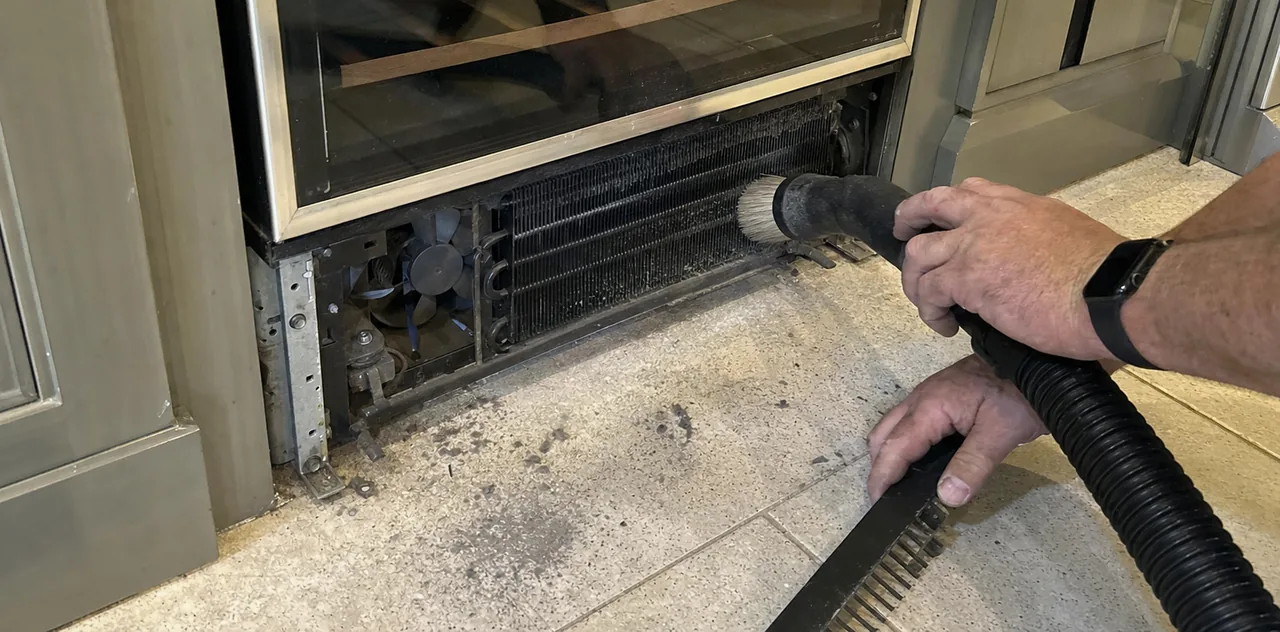
Aluminium fins hold salt, salt holds moisture, and the fin pack closes up with a white oxide bloom that insulates the coil and narrows the airflow path through it. Indoors, a mile inland, that process takes years. On an uncovered pool deck in 32082 it takes a small fraction of that, and the symptom is distinctive: the unit pulls down overnight when the deck is cool and loses ground every afternoon as the ambient rises, because a partially blinded condenser has no margin left for a hot day.
That is why we treat condenser condition as the first question on any outdoor call, regardless of what the appointment was booked for.
Corrosion you can see, and corrosion you cannot
The visible kind is cosmetic first and structural later. Tea-staining on stainless — brown bleeding that will not polish out — is surface iron contamination reacting with chloride, and it is the coast telling you the passive layer is under attack. Hinge pins, screw heads, handle mounts and grille fasteners go the same way, and a hinge that has stiffened with corrosion stops closing the door over the final half inch, which turns a cosmetic problem into a refrigeration one.
The kind you cannot see is at the electrical connections and the control board. Salt, humidity and roughly sixty-eight thunderstorm days a year are a difficult combination for any electronics, and a circuit that trips on hot afternoons and behaves perfectly the next morning is usually pointing at moisture ingress or a component that only misbehaves warm. Those are worth diagnosing properly rather than resetting repeatedly.
Covered, uncovered, and the difference it makes
The single largest variable in how long an outdoor unit lasts here is whether it lives under a roof. A unit in a covered summer kitchen with a decent overhang, set back from the prevailing easterly, ages at something close to an indoor rate. The same unit on an open deck with no cover takes sun, wind-driven salt and rain directly, and everything above happens several times faster.
If a unit is already installed in the open, cover is rarely an option, so interval is the lever instead. On this coast a twice-yearly condenser clean is the sensible baseline for an exposed unit, and the honest caveat is that cleaning restores airflow but does not restore metal that has already corroded.
Seasonal use, and leaving it running
Many of these units serve houses that are quiet for stretches of the summer. An outdoor refrigerator running empty for two months is not free — it is running through the hottest part of the year with nobody there to notice a change in its behaviour. Whether to leave it running or shut it down and dry it out is a real decision, and it depends on the install, the exposure and how long the gap is. It is worth asking before you lock the door.
How the visit runs
Readings first, in the conditions the unit actually works in. Flat diagnostic fee, credited toward the repair when you approve it, written estimate before anything is opened. Sealed-system work is carried out by EPA Section 608 certified technicians, and parts are genuine OEM ordered against your own serial plate.
What the visit includes
- Condenser and fin-pack assessment specific to a salt-exposed install
- Ambient and clearance check at the actual position, in real conditions
- Written estimate before any panel is removed or refrigerant is touched
- Genuine OEM parts ordered against your own model and serial plate
- 90 days on labour, 365 days on parts
From the journal
- Sub-Zero outdoor refrigeration on an exposed pool deck
Why an uncovered outdoor unit in Ponte Vedra Beach ages several times faster than the same appliance indoors, and which of that damage is preventable.
- Shutting a Sub-Zero down before a Ponte Vedra summer
What to do with refrigeration in a Ponte Vedra Beach house that will sit empty for months, and why the ice maker is the decision that matters most.
- Salt air, condenser coils and long run times
Why a Sub-Zero within a mile of the Atlantic runs longer every year, how to read the symptom correctly, and what corrosion on the fins actually means.
What it costs
What does a Sub-Zero outdoor refrigeration repair cost in Ponte Vedra Beach?
Most of this work lands between $240 and $820, parts and labour together, and the visit that decides which end of that you are at is a flat $80 credited to the repair once you approve it. The firm number is written down after the diagnosis, not guessed at over the phone.
| Work | Typical range |
|---|---|
| Diagnostic visit | $80 flat, credited to the repair |
| Evaporator or condenser fan motor | $250–$580 parts and labour |
| Electronic control board | $400–$820 parts and labour |
| Door gasket or seal replacement | $240–$650 parts and labour |
| Ice maker, water valve or supply line | $240–$670 parts and labour |
Written estimate before anything is opened up. The invoice carries one number; a band is what can honestly be published before the cabinet is open. The full table is on the pricing page.
Customer reviews
After a sub-zero outdoor refrigeration repair visit
4.8 out of 5 from 67 customer reviews. Each one below is a single visit, described by the person who paid for it.
The cabinet by the pool had stopped holding through the afternoon. He cleaned and treated a badly corroded fin pack and it is much better, though he was clear it will want doing again sooner than we would like.
Cormac E.2026-07-15
The unit on our pool deck was cutting out in the afternoon heat. He cleaned a condenser that was more salt than fin, replaced a tired fan motor, and it now holds through the hottest part of the day.
Imani Q.2025-09-25
Salt had seized a hinge pin on the outdoor drawers and the door was dragging on the frame. He freed and replaced the hardware and it closes squarely again. The staining on the stainless is still there, which he did warn us about.
Leopold F.2026-06-16
Questions we get asked
Answers before you call
- What does a Sub-Zero outdoor refrigeration repair cost in Ponte Vedra Beach?
- Most of this work falls between $240 and $820, parts and labour together: evaporator or condenser fan motor runs $250–$580, electronic control board runs $400–$820, door gasket or seal replacement runs $240–$650 and ice maker, water valve or supply line runs $240–$670. Which band your cabinet is in is what the diagnostic settles, and the figure on the written estimate is the one you are asked to approve.
- Is the $80 diagnostic charged on top of the repair?
- No. The $80 covers the visit and the whole diagnostic sequence, and it comes off the repair the moment you approve the work. Decide against it and the diagnostic is all you have spent: the written findings are yours to take anywhere you like. 90 days on labour, 365 days on parts, and genuine OEM parts on every repair.
- Why does an outdoor unit hold overnight and lose ground every afternoon?
- Because a condenser can only reject heat into the air it is standing in. Overnight that air cooperates; by mid-afternoon on a pool deck it does not, and a fin pack that is even partly blinded cannot shed the load. The pattern is a clue, and it points at the condenser first.
- Is rust around the hinges a repair or just wear?
- Usually neither on its own. Surface corrosion on exposed hardware in salt air is a maintenance job: hardware cleaned, treated, and replaced where it has gone past treating. What matters is reaching it before a hinge pin seizes and starts pulling the door out of alignment with the cabinet.
- How often should an outdoor condenser be cleaned here?
- More often than the same unit indoors, and more often than the same unit three miles west behind the marsh. Salt off the Atlantic holds moisture against aluminium and binds dust into the fin pack, so a deck-side cabinet runs on a much shorter cleaning clock than a manual assumes.