August 7, 2026 · diagnosis
Reading a warm fresh-food compartment
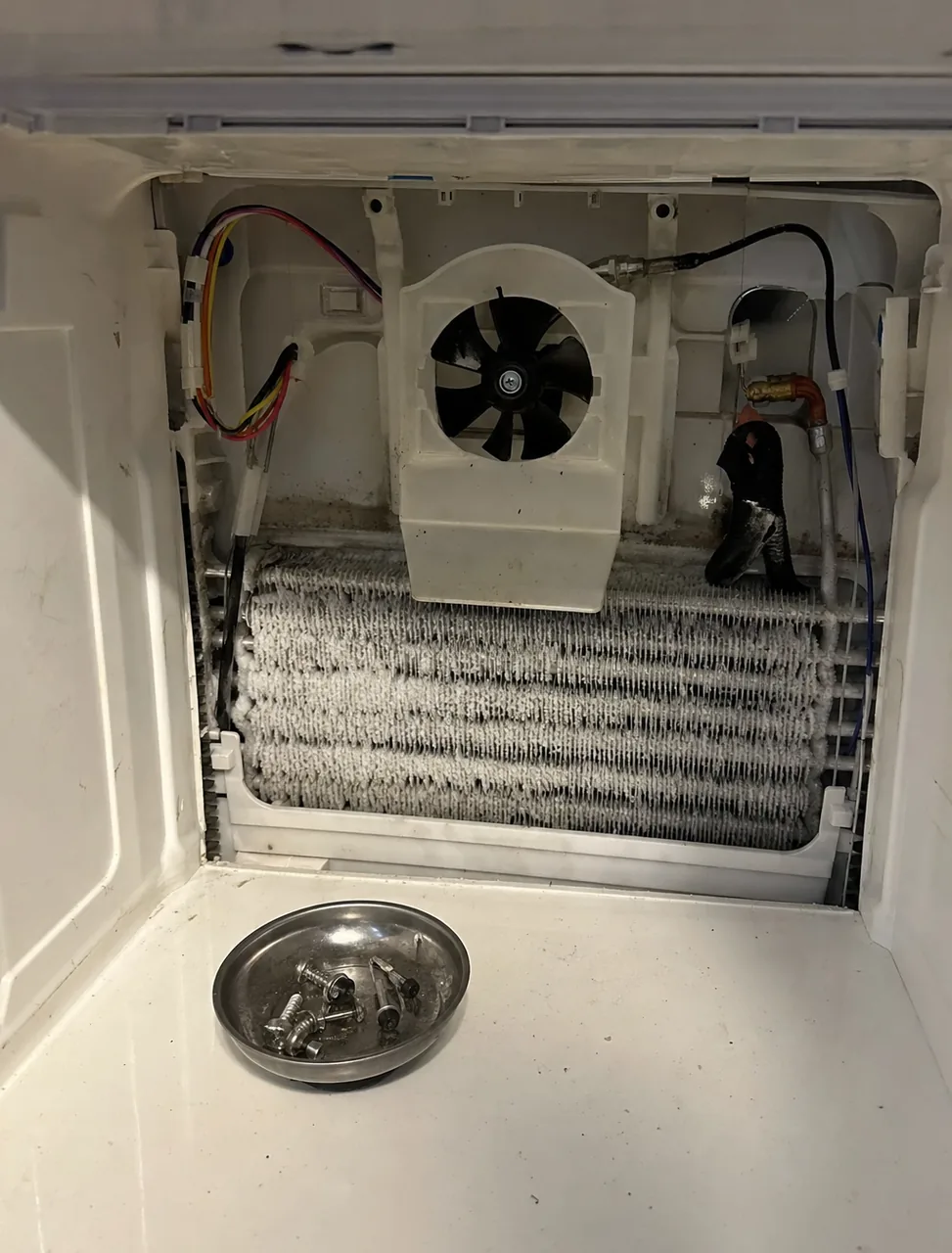
“The fridge side is warm but the freezer is fine” is the most common thing anyone says on the phone, and it is more informative than it sounds. It rules things out immediately, and it points at a small number of causes that fail in recognisably different ways.
The purpose of this piece is not to help you repair anything. It is to explain the order in which the possibilities have to be eliminated, so you can tell whether the person in your kitchen is working through it or skipping to the expensive end.
First: which compartments are affected
If one compartment is warm and the other is holding, the sealed system is usually not the problem — particularly on a dual-compressor unit, where each compartment has its own loop and a fault tends to stay where it starts.
If both compartments are drifting together, over weeks rather than hours, attention moves outward to the condenser and to airflow through the grille. In Ponte Vedra Beach that is a genuinely likely answer, because a fin pack full of salt corrosion produces exactly this pattern.
That single question splits the diagnosis in two before anything is opened.
Second: air, not cold
A refrigerator does not make cold for each compartment separately in every design; it makes cold at an evaporator and then moves it. So when one side is warm, the first question is whether the cold is being produced or whether it is simply not arriving.
Three things stop it arriving. A fan that has failed or slowed — often audible, and often worse once the motor is warm, which is why it can seem intermittent. A damper or air path obstructed by packaging, a tall bottle, or frost. Or an evaporator that has iced over to the point where the fan is pushing air through a solid block instead of across a coil.
The last of those is the most common single cause of a warm fresh-food side, and it is not really an airflow fault. It is a defrost fault.
Third: the defrost cycle
Every refrigerator that cools below freezing accumulates frost on the evaporator and periodically melts it off. If any part of that cycle fails — the heater, the sensing that terminates it, the control that initiates it — the frost is not fully cleared each time. What is left seeds the next cycle, and the coil closes up over a few weeks.
The signature is a compartment that gets gradually worse rather than suddenly worse, sometimes with a period of apparent recovery after the doors have been left open a while, because the extra warm air has done by accident what the defrost cycle should have done deliberately. Frost visible on the back wall of the freezer is often the same story seen from the other side.
There is a related failure worth naming because it is common in humid coastal houses: the defrost drain. Melt water has to go somewhere, and if the drain blocks, the trough refills and refreezes as a flat sheet. That sheet then blocks the air path, and you are back to a warm compartment by a completely different route. Water pooling under a crisper, or a slab of ice on the compartment floor, is that fault announcing itself.
Fourth: the doors
In a house near the water with the doors open to the pool deck, humid room air is a real load. A seal that has hardened, a hinge that has taken a set under the weight of a custom panel, or a door that no longer pulls itself shut over the last half inch will all add moisture and heat continuously. That produces both a warm compartment and heavier frosting on the evaporator, so it can imitate either of the faults above.
It is also the cheapest thing on this list to correct, which is a good reason to check it early.
Last: the sealed system
Only when air, defrost, drainage, doors and controls have been eliminated does refrigerant become the remaining explanation. It is the most expensive possibility and the least likely one, and reaching for it first is how a coil full of salt corrosion turns into a sealed-system invoice.
If someone proposes opening the sealed system on your unit, the reasonable question is which of the items above were ruled out and what the readings were. There should be an answer, and it should be written down.
What it costs
What does a Sub-Zero refrigerator repair cost in Ponte Vedra Beach?
Most of this work lands between $250 and $2,340, parts and labour together, and the visit that decides which end of that you are at is a flat $80 credited to the repair once you approve it. The firm number is written down after the diagnosis, not guessed at over the phone.
| Work | Typical range |
|---|---|
| Diagnostic visit | $80 flat, credited to the repair |
| Evaporator or condenser fan motor | $250–$580 parts and labour |
| Compressor or sealed-system repair | $860–$2,340 parts and labour |
| Defrost heater, thermostat or sensor | $250–$640 parts and labour |
Written estimate before anything is opened up. The invoice carries one number; a band is what can honestly be published before the cabinet is open. The full table is on the pricing page.
Customer reviews
Visits behind this note
4.8 out of 5 from 67 customer reviews. Each one below is a single visit, described by the person who paid for it.
The door alarm kept sounding with the door shut. It turned out to be a magnetic reed switch in the hinge column. The part sat on back order for a week, which was frustrating, but the fix itself was quick.
Colin W.2026-06-11
The crisper drawers had frozen everything in them while the top shelves read normally. He found a temperature sensor hanging loose behind the liner, refitted and recalibrated it, and both compartments settled inside a day.
Callum P.2026-09-16
Water was pooling under the crisper drawers every few days. The drain line had frozen solid at the check valve, so he cleared it, fitted a new valve and added a heater clip on the loop to stop the refreeze.
Devin S.2026-07-14
Questions we get asked
About Sub-Zero refrigerator repair
- What does a Sub-Zero refrigerator repair cost in Ponte Vedra Beach?
- Most of this work falls between $250 and $2,340, parts and labour together: evaporator or condenser fan motor runs $250–$580, compressor or sealed-system repair runs $860–$2,340 and defrost heater, thermostat or sensor runs $250–$640. Which band your cabinet is in is what the diagnostic settles, and the figure on the written estimate is the one you are asked to approve.
- Is the $80 diagnostic charged on top of the repair?
- No. The $80 covers the visit and the whole diagnostic sequence, and it comes off the repair the moment you approve the work. Decide against it and the diagnostic is all you have spent: the written findings are yours to take anywhere you like. 90 days on labour, 365 days on parts, and genuine OEM parts on every repair.
- Why is one side warm and the other still cold?
- Because on most built-ins a single evaporator feeds both, and the fresh-food side is downstream. Anything that obstructs that path — frost across the coil, a stalled fan, a blocked duct — starves the warm side first while the freezer holds on the cold air it already has.
- Why eliminate airflow and defrost before touching the sealed system?
- Because they imitate it exactly and cost a fraction of it to put right. A cabinet drifting warm reads the same to a hand on the door whether the fault is a fan or a leak, and opening a sealed system to find out is the most expensive possible way to ask the question.
Related